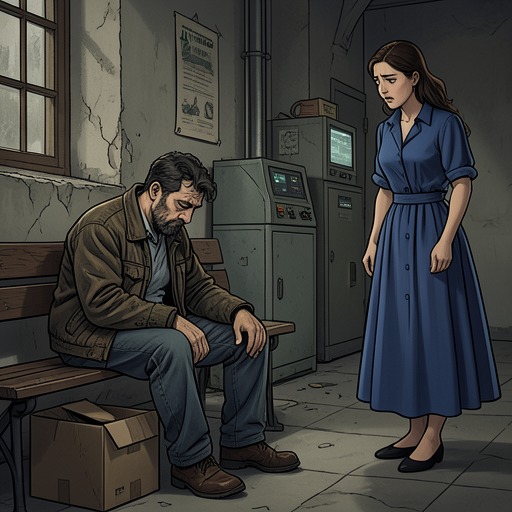
Tessa and Richard Reunite
After We FellTessa and Richard Reunite is a collision between childhood memory and a painful present. After nine years apart, Tessa recognizes her father in his familiar brown eyes but struggles to reconcile that recognition with the drunken, altered man standing before her. Hardin wants to leave; Tessa instead chooses to offer Richard a chance to speak, first over dinner and then under her roof for the night. The reunion reopens the question of what, if anything, can be recovered after abandonment.
The Stranger in a Familiar Face
Tessa’s first response is disbelief. The man before her cannot, in her mind, be her father, despite the brown eyes she knows. She is frozen, unable to find words for what she experiences as a drunken stranger wearing her father’s face. Recognition arrives in fragments rather than as an uncomplicated welcome: Richard’s brown beard is peppered with gray, and his smile no longer resembles the clean, familiar one she remembers. The physical details make the passage of time visible, while Tessa’s shock registers the distance between the father she recalls and the person who has returned.
That distance is also emotional. Tessa remembers a father who lifted her onto his shoulders and ran through their small yard, but she also remembers that he left. His nickname for her, Tessie, belongs to those better times, and hearing it makes her heart sink rather than simply comforting her. The name carries affection and loss at once: it reconnects her to childhood while reminding her that the relationship behind that intimacy was broken. Tessa’s response is correspondingly divided. She wants to cry, laugh at the irony of their meeting, and yell at him for leaving.
Her hopes for Richard have already been measured against change in another person. She had once hoped he might turn his life around as Ken did; seeing him now makes that hope vanish. Yet his manner complicates the comparison. Tessa remembers him as an angry drunk, whereas this Richard is smiling, showing his tattoos, and shaking hands with Hardin. She wonders whether he has become a nicer man, but the scene leaves that possibility unsettled: a friendly first impression cannot by itself answer what has changed or undo the years of absence.
Hardin’s Warning and Tessa’s Choice
Hardin’s reaction gives the reunion an immediate practical tension. He turns toward Richard with blazing eyes, puts a hand on Tessa’s shoulder when she is unable to respond, and later says it is time to go. He expects the encounter to end badly and urges Tessa away. His concern stands against her impulse to approach her father, making the scene a conflict not only between past and present but between protection from likely hurt and the possibility of renewed contact.
Tessa does not treat Hardin’s prediction as certainty. Although she knows he may be right, she feels she owes it to herself to try to know Richard, or at least hear what he has to say. That distinction matters: she does not claim that the reunion restores trust, nor does she promise forgiveness. She chooses a limited next step in the face of uncertainty. Her invitation to dinner is an attempt to learn more, not proof that the nine-year separation has been resolved.
Richard, meanwhile, apologizes for the long absence and says it was not all his fault, directing blame toward Tessa’s mother. He asks for a chance and addresses Tessa by her full name, Theresa, as he pleads. The appeal makes his desire for another opportunity explicit, but the explanation also arrives with an evasion: rather than taking responsibility without qualification, he invokes the conflict with her mother. Tessa’s decision to listen therefore does not settle the account of why he left.
Dinner, Shelter, and an Unfinished Reunion
The offer of dinner changes the encounter from a chance meeting into a tentative act of hospitality. Tessa asks Richard to come to her and Hardin’s place, and he responds with visible hope. The choice is significant precisely because it is small and concrete. She cannot restore their old family life in a single exchange, but she can allow the conversation to continue beyond the first shock and his request for a chance.
At the end of dinner, Richard stands to leave and expresses appreciation for the meal. Tessa then offers to let him stay that night and says they can take him back home in the morning. She hesitates over how to describe his situation, and her uncertainty keeps the offer from seeming effortless or fully secure. Hardin dislikes the arrangement, but Tessa extends it anyway. The overnight stay turns her willingness to hear Richard into a practical response to his immediate circumstances, without establishing what their relationship will become afterward.
The scene ends not with reconciliation but with a temporary opening. Tessa has moved from paralysis to an invitation, while the tensions surrounding Richard’s drinking, his departure, and his explanation remain unresolved. The familiar nickname and the remembered father survive alongside the changed face in front of her; neither cancels the other. By allowing Richard to stay for one night, Tessa makes room for a possible next conversation, while the brief, cautious terms of her offer preserve the uncertainty at the heart of their reunion.